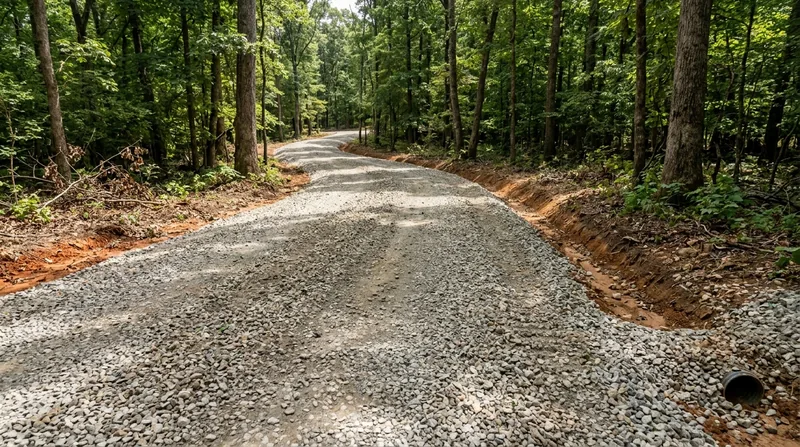




Gravel driveways across Warren County and rural Bowling Green face one relentless problem: clay that holds water. After heavy rain, low spots pool and soften the base, edges crumble, and ruts form where tires track through mud. Gravel driveway installation and grading in Bowling Green means cutting a proper crown, compacting stone in lifts, and pitching the surface so water runs off instead of sitting. We build driveways that shed water the way they should, using real grading technique suited to the red clay, limestone karst, and fifty inches of annual rain that define this region. Whether you're replacing a failed lane on a rural property or upgrading a home entrance in the subdivisions spreading toward the Corvette plant, a well-graded gravel drive lasts years longer and costs a fraction of asphalt. Call (270) 938-6628 for a free estimate, or read on to understand how proper grading solves the water problem.
Why Gravel Driveway Grading Matters in Bowling Green's Clay and Karst Terrain
Bowling Green sits on gently rolling hills over red clay that absorbs and holds water like a sponge, with cavernous limestone underneath riddled by sinkholes. A driveway that looks flat will pool water in the center or at the low end after a hard rain, and standing water softens the stone base, collapses the surface, and opens ruts that grow wider every time a vehicle passes. The freeze-thaw cycles that arrive in winter, even if mild, push water up and down through the base, and the cycles break stone and compact. Proper grading solves this: a crowned surface sheds water to both sides, pitched lanes push water toward the road or a drainage swale, and a compacted stone base in lifts handles the load without settling into soft spots. Without grading, a gravel drive becomes a mud lane by spring.
- A crowned center or pitched surface prevents water from pooling in the middle or at low ends after rain.
- Compacted stone base in lifts, typically 4 to 6 inches, resists settling and handles vehicle weight without ruts.
- Proper pitch toward the road or a drainage swale keeps water moving away from the driveway structure.
- Grading on clay terrain in Warren County stops the freeze-thaw cycles from collapsing the base each winter.
- A well-graded gravel drive lasts 3 to 5 years with light maintenance, while a flat, poorly drained lane fails in one season.
Grading is the difference between a driveway and a muddy lane, and in Bowling Green's climate and soil, it is not optional.
Key info: Rural Warren County roads like those in Plum Springs, Smiths Grove, and Oakland often fail because the original grading was minimal or nonexistent. We cut a proper crown, compact the base, and pitch the surface to the road. The result is a driveway that sheds water instead of absorbing it.
How We Install and Grade Gravel Driveways in Bowling Green: Step-by-Step Process
We start with a site assessment to understand the slope, the soil, the water flow, and the intended use. From there, we cut a crown or pitch, excavate and remove any failed material, bring in compacted stone in lifts, and finish with a top layer that sheds water. The work is straightforward, but the precision matters: a crown that is too shallow does not shed water, and one that is too steep makes it hard to drive. We match the grade to the property, the soil, and the intended drainage.
- We survey the site and identify the high and low points, the direction of water flow, and any existing drainage.
- We excavate and remove failed material, clay, or vegetation down to firm subgrade, and we grade to the proper slope.
- We bring in compacted stone base in 2 to 3-inch lifts, compacting each lift with a plate compactor or roller until it is firm.
- We top with a finish layer of crushed stone or recycled millings, pitched to shed water toward the road or a swale.
- We verify drainage by walking the drive and confirming water flows away from the center and ends.
The entire process typically takes one to two days for a residential driveway, and the result is a surface ready to handle vehicles and rain.
Example: A home in Woodburn with a 150-foot lane over red clay and a low spot near the road received a new crowned and pitched gravel drive with 5 inches of compacted base and a 2-inch finish layer. Water now runs to the road instead of pooling, and the drive has held firm through two winters. The cost was under $1,800 and saved the homeowner from having to repour asphalt.
If you are considering asphalt driveway paving as an alternative, gravel is often the right starting point on rural property, and it can be upgraded to asphalt later if needed.
Gravel Driveway Installation Methods and Materials
| Approach | Description | Best for |
|---|---|---|
| Crushed stone base with gravel finish | 4 to 6 inches of compacted crushed stone (typically 3/4-inch), topped with 2 inches of washed or angular gravel. | Rural driveways, light to moderate use, budget-conscious homeowners, areas where drainage is the priority. |
| Recycled asphalt millings base and top | 4 to 6 inches of compacted recycled asphalt millings (RAP) as base, 1 to 2 inches of RAP as finish, which binds slightly over time. | Rural driveways where a firmer surface is desired, moderate use, cost-effective alternative to asphalt, good for water shedding. |
| Recycled asphalt millings over stone base | Compacted stone base (4 inches) with a 2 to 3-inch layer of recycled asphalt millings on top for a more stable, less dusty surface. | Homeowners wanting a semi-bound surface, less maintenance than pure gravel, better traction in wet conditions. |
| Engineered grading with minimal stone | Proper crown and pitch cut into existing soil or clay, topped with 1 to 2 inches of gravel for traction, minimal stone base. | Low-traffic lanes, temporary or seasonal access, very tight budgets, areas where water drainage is excellent. |
Gravel Driveway Installation and Grading Cost in Bowling Green: What to Expect
A basic gravel driveway with proper grading and a compacted stone base starts at $950 for a short residential lane (under 50 feet), and typical costs for a 100-foot rural driveway range from $1,400 to $2,200 depending on the slope, the soil condition, and the materials chosen. The biggest cost drivers are the length of the lane, the amount of excavation needed to remove failed material or establish proper slope, the type and depth of stone base, and the finish material. A driveway that is steep or requires significant grading work, or one that needs a thick stone base because the subgrade is soft, will cost more. A short, gentle lane on firm ground with minimal excavation will cost less. We provide a written estimate with tonnage and material specifications so you know exactly what you are paying for.
Several factors affect the final price. A longer driveway (150+ feet) or one with a significant elevation change requires more material and labor. If the existing surface is failed asphalt or packed clay, removal and disposal add cost. The type of finish matters too: standard crushed stone is the most affordable, recycled asphalt millings cost slightly more but bind over time and require less maintenance, and a stone base with a gravel top offers a middle ground. Access also plays a role: if heavy equipment can move freely, the job is faster and cheaper; if the lane is narrow or bordered by trees, we work slower and may need smaller equipment.
The best way to know the cost for your property is to request a free estimate. We measure the site, assess the soil and slope, and give you a firm quote with no obligation. Most estimates are ready within 24 hours, and we are happy to explain the specifications and answer questions about materials and grading technique.
What to Look for When Hiring a Gravel Driveway Contractor Near Bowling Green
A gravel driveway is simpler than asphalt, but the grading work is where the quality lives. A contractor who rushes the base prep, skips compaction, or does not pitch the surface properly will leave you with a muddy lane by spring. When you call to get an estimate, ask these questions and verify the answers before you commit.
- Ask for a written estimate that includes the length and width of the driveway, the depth and type of stone base, the finish material, and the tonnage or yardage of material.
- Verify that the contractor is fully insured and ask to see a current certificate of insurance covering general liability and vehicle coverage.
- Ask about the compaction method: a plate compactor or vibratory roller is the right tool; hand tamping or no compaction at all is a red flag.
- Confirm that the contractor will establish a proper crown or pitch and explain how water will be shed from the drive.
- Get references from other homeowners in Bowling Green, Franklin, or Plum Springs who have had gravel drives installed, and call at least two to ask about durability and maintenance.
- Check that the contractor is local and has been in business for several years; a local address and local phone number are trust signals in this trade.
Avoid contractors who offer a price over the phone without seeing the site, who ask for a large cash deposit upfront, or who do not provide a written contract and estimate. A good contractor will take the time to assess your property, explain the work, and stand behind the result with a reasonable workmanship warranty.
If you are also considering asphalt paving in Bowling Green or other paving work, the same standards apply: get multiple estimates, verify insurance, and ask for references. We are happy to provide all three, and we are available at (270) 938-6628 to answer any questions about how we grade and build driveways on Bowling Green's challenging clay and karst terrain.
Gravel Driveway Installation & Grading in Bowling Green: Pricing Guide
| Service | Price | Details |
|---|---|---|
| Residential gravel driveway, short lane (under 50 feet) | Starting at $950 | Includes site grading, compacted stone base, and finish layer with proper crown or pitch for water drainage. |
| Residential gravel driveway, standard length (100 feet) | $1,400 to $2,200 | Length, soil condition, elevation change, and finish material (crushed stone or recycled asphalt millings) are primary cost drivers. |
| Rural lane with significant grading or removal of failed surface | On estimate | Excavation depth, subgrade condition, slope, and material disposal require an on-site assessment before a firm quote can be provided. |
| Recycled asphalt millings upgrade or alternative finish | Add $200 to $500 | Recycled millings cost more than standard gravel but bind over time, require less maintenance, and offer better traction in wet conditions. |
| Travel and site assessment | Included | No separate mileage fee or call-out charge in Bowling Green and surrounding Warren County service areas. |
| Free written estimate | Free | Response within 24 hours at (270) 938-6628; includes tonnage, material type, and labor scope with no obligation to book. |
Indicative pricing, the exact cost depends on square footage, finish, and site access. Free personalized estimate within 24h at (270) 938-6628.


