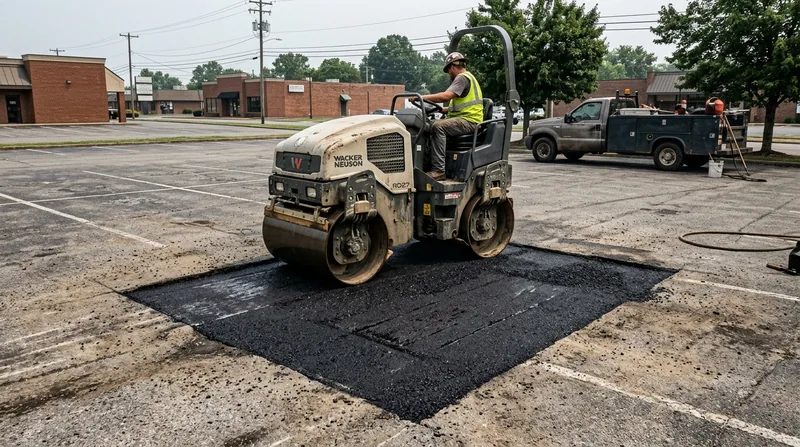




Pothole Repair & Asphalt Patching in Bowling Green demands a different approach than patching in drier climates. Bowling Green sits on red clay over limestone riddled with sinkholes, and the city's humid subtropical weather, roughly 50 inches of rain a year, freeze-thaw cycles down to 24 inches, and hot, humid summers, creates ideal conditions for potholes to open up and spread. Water pools over soft ground, clay stays saturated through the season, and asphalt edges break where drainage fails. A pothole that starts small in spring can double in size by summer if left unpatched, and the cost of repair climbs fast once the base fails. We cut back to solid material, tack the edges, and pack hot mix in lifts so the repair holds through the next heavy Kentucky downpour.
Why Pothole Repair Matters in Bowling Green's Clay and Limestone Country
Potholes in Bowling Green are not just cosmetic damage. They start where water sits over the soft, clay-covered limestone that underlies most of Warren County's residential neighborhoods, from the older areas near downtown and Western Kentucky University through the ranch-house belt and into the fast-growing subdivisions pushing toward the Corvette plant. The clay holds water, the limestone beneath is cavernous and unstable, and freeze-thaw cycles force moisture up and down through the pavement. A small crack becomes a spall, a spall becomes a pothole, and a pothole left unrepaired can undermine the entire base within weeks of heavy rain.
- We identify the extent of base damage beneath the surface before we quote the repair.
- We remove all failed asphalt and soft clay, cutting back to solid ground or base course.
- We tack the cut edges with a bonding agent so the patch adheres and does not separate.
- We compact new hot mix asphalt in lifts, usually two or three layers, and finish flush with the surrounding surface.
- We allow the patch to cure before the driveway is opened to traffic.
Early repair prevents a small failure from becoming a full-depth replacement. See our driveway repair page for more on when patching makes sense and when the damage calls for resurfacing.
Local example: A driveway in the WKU-adjacent neighborhoods off Chestnut Street can show alligator cracking and edge failure by year three or four because water runs off the slope into the clay base. A properly executed patch there holds because we remove the failed material and compact the new asphalt to spec, but a temporary fill or cold-patch mix will fail again within a season.
For guidance on permitting and local requirements, contact the City of Bowling Green Public Works Department.
How We Handle Pothole Repair and Asphalt Patching in Bowling Green
A pothole repair begins with an honest assessment. We arrive on site, measure the damage, probe the surrounding asphalt for soft spots, and determine whether patching will hold or whether the base failure is too extensive. If the pothole is isolated and the surrounding asphalt is sound, a patch is the right call. If the damage is part of a larger pattern of cracking or settlement, we explain why resurfacing or full-depth repair makes better economic sense.
- We use a gas-powered saw or jackhammer to cut the pothole back to solid base material, usually in a rectangular shape for easier compaction.
- We remove all debris, sweep the cut clean, and inspect the base for moisture or further softness.
- We apply a tack coat (an asphalt bonding agent) to the cut edges and base so the new mix bonds tightly.
- We heat the new hot mix asphalt to the proper temperature and compact it in layers using a vibratory compactor.
- We finish the patch flush with the surrounding surface and allow it to cool before traffic resumes.
Real-world case: A pothole opened up on a driveway in Plum Springs after a heavy spring rain exposed a soft spot in the clay base. We cut back 18 inches in all directions, removed the failed material, and compacted a three-inch patch in two lifts. The repair has held for five years because the base was solid beyond the failure zone and the tack coat created a permanent bond.
If a pothole is part of widespread damage, we recommend asphalt resurfacing or overlay to protect your investment long-term.
Pothole Repair Methods and When to Use Each
| Method | Description | Best for |
|---|---|---|
| Full-Depth Patch | Cut back to base course or subgrade, remove all failed material, compact new hot mix in lifts with tack coat between layers. | Isolated potholes with solid base material beyond the failure zone; the most durable repair method. |
| Semi-Depth Patch | Cut back 4 to 6 inches into the existing asphalt, remove all soft material, apply tack, and compact new hot mix to the original surface. | Shallow failures or edge breaks where the base is solid; faster and less expensive than full-depth. |
| Spray Injection or Slurry Seal (Not Recommended for Potholes) | A thin overlay applied over existing damage without removing failed material; temporary and often fails within one season in Bowling Green's climate. | Not recommended for potholes; better suited to sealed cracks or minor surface wear on otherwise sound asphalt. |
| Temporary Cold Patch (Emergency Only) | Cold-mix asphalt applied without heating or compaction; no bonding agent; used only to prevent further damage until a permanent repair is scheduled. | Emergency stops only; will fail within weeks in freeze-thaw cycles and heavy rain; not a permanent solution. |
We use full-depth or semi-depth hot mix patches because they bond permanently and hold through Bowling Green's heavy rain and seasonal freeze-thaw cycles. Cold-patch or spray-seal methods fail quickly in our climate and waste your money.
Pothole Repair and Asphalt Patching Cost in Bowling Green: What to Expect
Pothole repair costs depend on the size of the failure, the condition of the base material, and whether the pothole is isolated or part of a larger pattern of damage. A single pothole on an otherwise sound driveway costs less than multiple failures or widespread cracking that signals base failure across the entire surface. We provide a written estimate that includes the square footage, the depth of the cut, and the tonnage of new asphalt so you know exactly what you are paying for.
- A single small pothole (under 2 square feet) typically runs from $450 to $650 for full-depth repair with tack coat and proper compaction.
- Multiple potholes or larger failures (2 to 10 square feet per pothole) range from $150 to $250 per pothole depending on depth and base condition.
- Extensive alligator cracking or settlement across more than 30 percent of the driveway usually calls for resurfacing rather than patching, which costs more upfront but protects your investment longer.
- Travel to Bowling Green, Plum Springs, Plano, Woodburn, Oakland, and nearby areas is included with no separate mileage fee.
- We provide a free written estimate within 24 hours of your call to (270) 938-6628.
The biggest factor that moves cost up is the depth of the cut and whether the base material is solid or requires removal and replacement. A pothole over a soft clay layer costs more to repair properly than one over a stable gravel base. See our full pricing page for more detail on repair and resurfacing costs.
Cost example: A driveway in Smiths Grove with two potholes, each about 1.5 square feet and 4 inches deep, over solid base material, cost $850 total for both repairs including tack coat, compaction, and finishing. The same job over soft clay that required 6 inches of excavation would have run $1,100 to $1,300 because of the extra material removal and base prep.
Getting two or three estimates is smart practice. Each contractor should provide a written quote that shows the square footage, the depth, and the tonnage of asphalt. If an estimate is vague or significantly lower than others, ask why before you commit.
Pothole Repair and Asphalt Patching Near Me: What Bowling Green Homeowners Should Know When Hiring a Contractor
Hiring the right asphalt contractor matters because a poorly executed patch will fail within a season, and a contractor who cuts corners on base prep or compaction leaves you with a temporary fix disguised as a permanent one. In Kentucky, paving contractors are not licensed by the state, so licensing and permitting rules are set by the city or village where you live. Before you hire any contractor, verify their insurance coverage and ask to see a certificate. Request references from recent jobs in Bowling Green or nearby areas, and check that they provide a written estimate with tonnage and thickness specifications.
- Ask whether the contractor is fully insured and request a current certificate of insurance before work begins.
- Confirm that the estimate includes the square footage of the repair, the depth of the cut, and the tonnage of new asphalt material.
- Check references from homeowners in Bowling Green, Plum Springs, or Woodburn who have had pothole repairs or patching done in the last two years.
- Verify that the contractor will use hot mix asphalt compacted in lifts, not cold patch or temporary fill.
- Understand whether your city or HOA requires a permit for the work; the contractor should help you navigate local requirements, not promise to pull all permits.
- Avoid contractors who offer unsolicited door-to-door service, demand a large cash deposit upfront, or quote a price that seems too good to be true.
We are fully insured, we provide written estimates with tonnage and thickness, and we have been in business since 2011 serving Bowling Green and Warren County. Contact us for a free estimate and we will walk you through the repair process and answer any questions about permitting or timeline.
Pothole Repair & Asphalt Patching in Bowling Green: Pricing Guide
| Service | Price | Details |
|---|---|---|
| Single small pothole (under 2 sq ft) | Starting at $450 | Full-depth repair with tack coat, hot mix compaction in lifts, and finishing flush with surface |
| Multiple potholes or larger failures | $150-$250 per pothole | Cost per pothole depends on depth of cut and whether base material is solid or requires removal and replacement |
| Extensive cracking or settlement (30%+ of surface) | On estimate | Patching is not cost-effective; resurfacing or full-depth replacement is recommended and requires on-site assessment |
| Travel to Bowling Green and surrounding areas | Included | No separate mileage fee or call-out charge for service areas within Warren County and nearby cities |
| Free written estimate | No charge | Response within 24 hours at (270) 938-6628; estimate includes square footage, depth, and tonnage of asphalt material |
Indicative pricing, the exact cost depends on square footage, finish, and site access. Free personalized estimate within 24h at (270) 938-6628.


